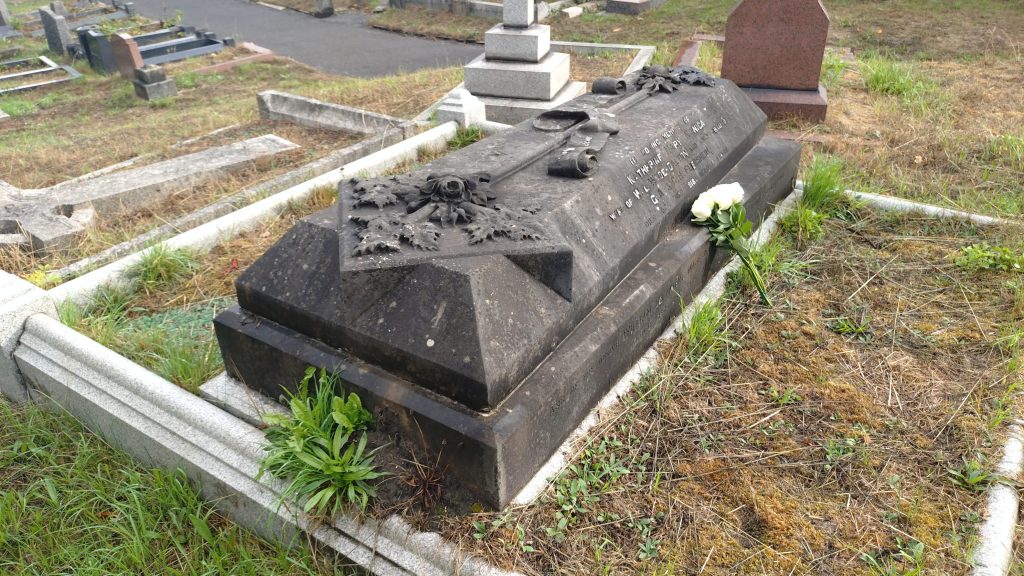
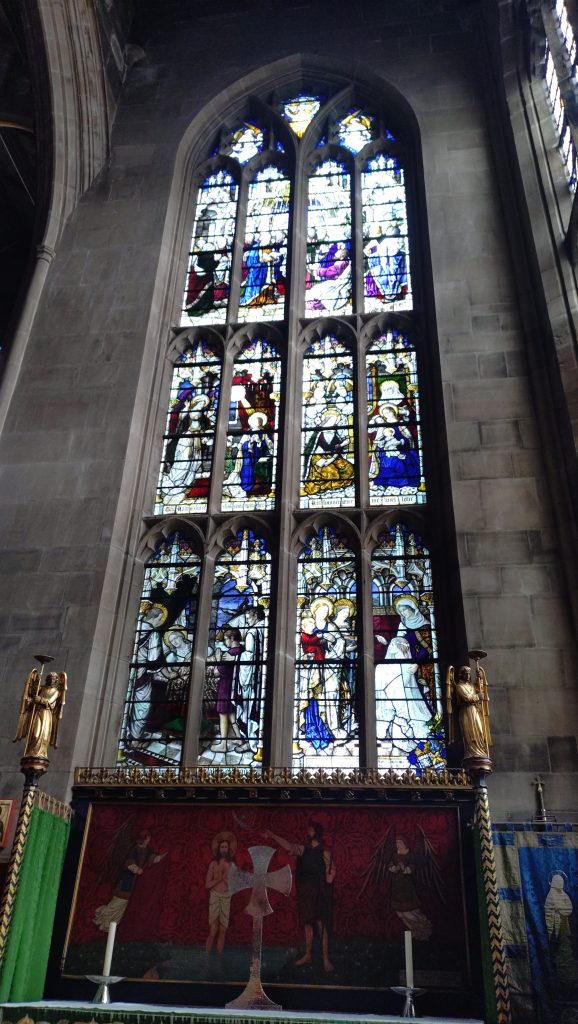
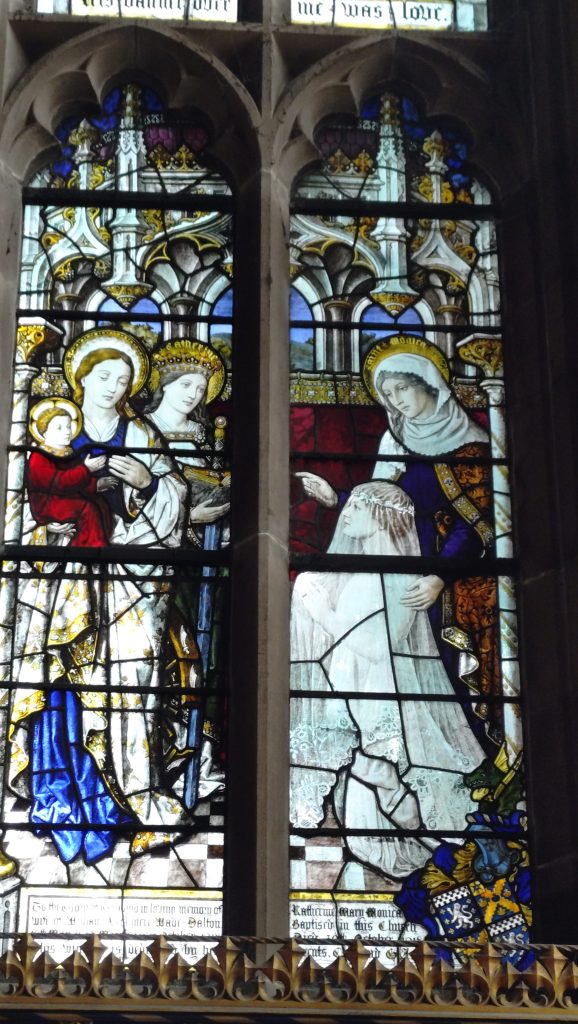
Standing as arguably the finest medieval building in Nottingham, if not the entirety of England, the Church of St Mary is a true historic centerpiece. Over the centuries, the renowned Lace Market steadily grew around its grounds. Like most churches of its era, St Mary’s has been carefully adapted and expanded as the years have passed. Added in 1913 adjacent to the Choir and Chancel, the Chapel of the Holy Spirit features an east-facing window dedicated to the memory of Katherine Wade-Dalton (née Flersheim). As the First World War drew to a close on October 23, Katherine and Captain William L. Wade Dalton celebrated their marriage at St Mary’s Church. Yet, the joy was devastatingly brief. A mere week later, on October 30, Katherine’s life was claimed by the influenza pandemic; she died of heart failure while on her honeymoon at the Royal Bath Hotel in Bournemouth. In the window, Katherine is portrayed in her wedding dress, elegantly draped in a long veil of Nottingham lace. She kneels as if awaiting a blessing, while the Virgin Mary, or perhaps another female saint, gently rests a comforting hand upon her shoulder. Marked by a majestic headstone, her remains rest in a family plot deep within the ‘Rock’ section of Church Cemetery. Though time has sadly weathered the stone’s lettering, her name remains softly legible.
Katherine Flersheim was born on March 20 1899 at Lenton Avenue, The Park, Nottingham, to Gustave, a lace merchant of German origin, and Caroline (nee Hardy). She was their first and would remain their only child, adding the already tragic circumstances of her death nineteen years later. Katherine was baptised in St Mary’s Church on May 10.
According to the 1901 Census, the Flersheim family lived at 11 Lenton Avenue with three servants, reflecting their affluence. By 1911, they had relocated to 13 Pelham Crescent, where twelve-year-old Katherine attended school and the family employed a governess.
Accessible evidence offers no clues as to when Katherine left school and what she did afterwards. The end of her formal schooling will likely have coincided with the outbreak of the First World War. I expect Katherine contributed to the war effort. Given Nottingham’s pivotal role as a major industrial center—housing the UK’s largest shell-filling factory at Chilwell and serving as the operational heart for the Boots pharmaceutical empire—it is entirely likely that she contributed to the local wartime effort, whether in munitions production or auxiliary services.
Katherine eventually crossed paths with Welsh-born Captain William Lechmere Wade Dalton. Despite being sixteen years her senior, the two began a courtship that culminated in their engagement and wedding.

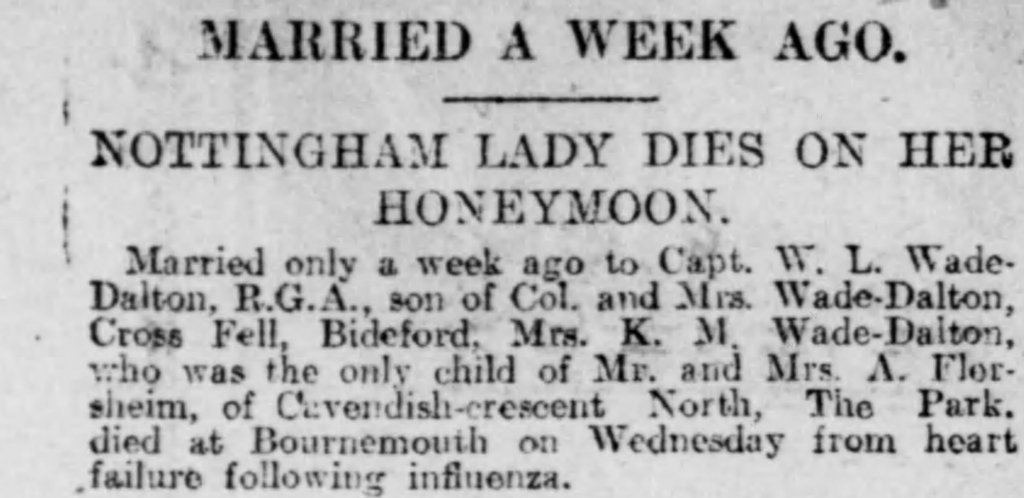
Katherine’s body was returned to Nottingham from Bournemouth for a funeral service on November 4, likely at St. Mary’s Church before her final interment in Church Cemetery. She would ultimately be immortalized in the church’s memorial window.
Beyond the acute grief of William, widowed after only seven days of marriage, the loss shattered Gustave and Caroline, who were stripped of their only child. For Caroline, the heartbreak was compounded the following year when Gustave also passed away, leaving her to endure the family’s profound double tragedy in solitude. Surviving her daughter by twelve years, Caroline passed away in 1930, ultimately joining Katherine and Gustave in their final resting place.
Though more than half a century passed before they were reunited, William never truly forgot his first bride. In 1932, at the age of forty-eight, he married thirty-six-year-old Anne Roseamond Gott in London, though the couple had no children. William passed away on Christmas Day in 1972 at the age of eighty-nine. True to a lifelong devotion that outlasted decades, his final wish was honoured on New Year’s Day 1973, when he was finally laid to rest beside Katherine and her parents in Church Cemetery.
Acknowledgments: The author wishes to thank Adele Siepmann. Operations Manager at St. Mary’s Church, Nottingham, and Sarah Valmai Rowley at Nottingham City Council Bereavement Services for their help and support.
Sources: Online and Digital – Ancestry, Deceased Online, Find A Grave, General Registry Office, Nottingham City Council Bereavement Services, St Mary’s Church, Nottingham
Books: Laura Spinney, Pale Rider, the Spanish Flu of 1918 and how it changed the World, 2017, Vintage Publishing.

