Kirriemuir is a quaint town nestled on the edge of the beautiful Angus Glens, an area cherished for its natural splendour. With a rich and storied history, this former royal burgh holds a special place in the hearts of its residents, particularly because of its connection to James M. Barrie, the beloved author of Peter Pan. The town takes great pride in honouring this literary legacy, with heartfelt tributes to both Barrie and the poignant story of the boy who never grew up scattered around Kirriemuir. It’s deeply touching to note that Barrie rests in the local cemetery, where we also find the grave of six-year-old Charles Strachan Barrie—another boy who, though tragically, shares a connection to the theme of childhood that Barrie so beautifully captured.
Charles Strachan Barrie passed away from meningitis after a fifteen-day battle with influenza at 3 Grant’s Road, Kirremuir, on Sunday, October 27th, his sixth birthday. He is buried in Lot 401, although his name is not inscribed on either headstone at the site. Nonetheless, he is commemorated on his parents’ headstone in St Andrews’ Western Cemetery, ensuring his memory is honoured. I suspect, although I cannot confirm, that he is buried alongside relatives. There is a compelling possibility, though not definitively established, that Charles may be connected to the esteemed J.M. Barrie.
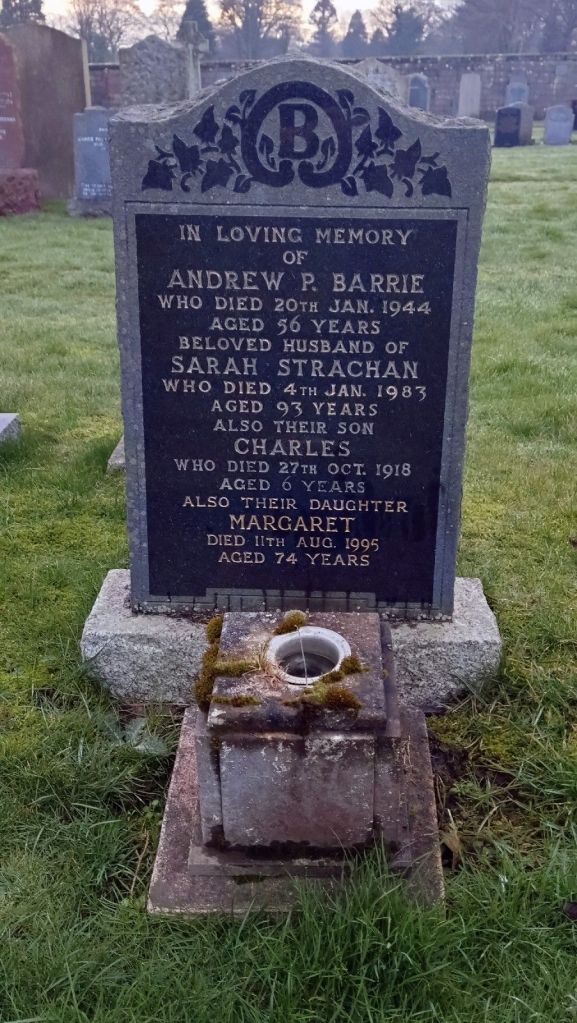

Charles was born on October 27, 1912, at 3 Grant’s Road. He was the eldest son of Andrew, a baker, and Sarah (née Strachan). The couple had married in Fife on August 11th the previous year, and Charles was their first surviving child. He would later be joined by his brother Robert, who was born the day before Charles’ birthday in 1914.
Given that Charles was born and passed away between 1911 and 1921, he does not appear in the Census data. It is likely that he spent his entire, albeit tragically brief, life in Kirriemuir, where he would have attended school when he reached the appropriate age. This context helps us understand the environment in which he lived and the experiences he might have had during his formative years.
Andrew, like many able-bodied young men of his time, served in the armed forces during the First World War. He began his service in the Royal Air Force (RAF) on February 16, 1916. His enlistment occurred shortly before conscription was mandated by the 1916 Military Service Act, indicating that he voluntarily joined. Notably, Andrew formally registered his son’s death, implying that he was on home leave at the time.
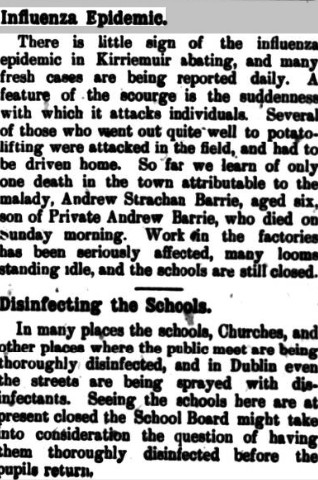
Charles’ death garnered considerable attention from local media, highlighted in an article about the rising prevalence of Spanish influenza in the Kirriemuir Free Press and Angus Advertiser on November 1st. At the time of publication, he was the only reported death in Kirriemuir—a distinction that would likely soon change. His obituary in the same newspaper recognised the suddenness of his passing and affirmed that he was “deeply mourned” by his family.

Shortly after Charles’s death, his sister Isabella was born in December, offering a glimmer of hope and joy to the heartbroken family. Andrew and Sarah welcomed two additional children: their daughter, Margaret, was born in 1921, followed by their son, James, in 1926. By the time James arrived, the Barrie family had moved from Kirriemuir to North-East Fife. Andrew spent the rest of his life in Fife, passing away in St. Andrews on January 20, 1944, at the relatively young age of 56. His wife, Sarah, outlived him by thirty-nine years, dying on January 4, 1983, at the impressive age of 93. She also outlived her son Robert by three years.
Sources: Ancestry, British Newspaper Archive, Find a Grave, Scotland’s People, Scottish Memorial Inscriptions.
 Broken Columns