Camelon Cemetery is one of my favourites. The cemetery is a diverse smorgasbord of headstone designs, spanning from the late Victorian era to the present day. James Cowan rests near the Cemetery’s War Memorial. James died at the King George V Military Hospital in Dublin on October 25 1918, aged twenty-eight, from influenza and pneumonia. His grave is marked by a worn yet still legible headstone, which is cared for by the Commonwealth War Graves Commission (CWGC).
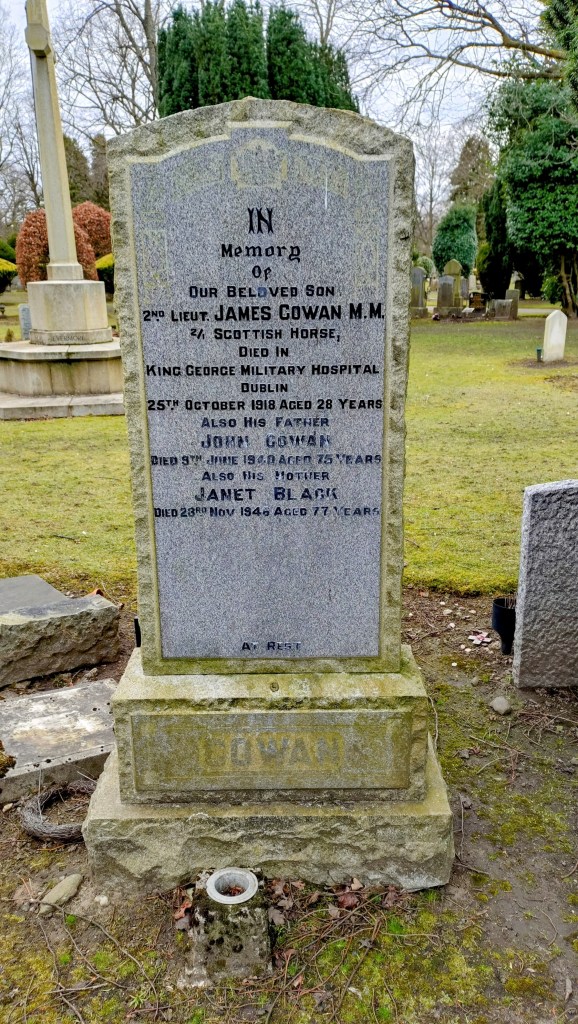
James was born on November 2 1889, at Langlands, Dunipance, to farm servant John and Janet (nee Black). The couple had married the year before, and James was their first child.
I was unable to find James in the 1891 Census records, which is rather unusual. He may have been accidentally omitted or in the care of extended family or friends when the Census was taken.
By 1901, an eleven-year-old James resided with his family at Carmuirs, Falkirk and was attending school. The family had grown considerably with the addition of his brother and three sisters.
Ten years later, James was employed as a cab driver at the Crown Stables. He still lived with his family, by which time the family had relocated to 9 Melville Street, Falkirk. He would later join the Glasgow Police Force and serve in the Northern Division.
As with the vast majority of able-bodied young people, James served in the First World War. He enlisted voluntarily and served in the Household Cavalry Regiment, in the Scottish Horse Battalion. He would rise to the rank of Second Lieutenant. He was active in various campaigns, starting with the ill-fated Gallipoli. This was followed by service in Egypt and Salonica. His devotion and gallantry earned him the award of the Military Medal.
James’s presence in Dublin at the time of his death raises some interesting questions. It is possible that he was discharged from the front line because of injury and was recovering in Dublin because a bed was available at the George V Hospital. However, I suspect he was deliberately stationed there to quell the threat of revolution from Irish Republican forces. The failure of the 1916 Easter Rising and the harsh retaliation from the British Army dealt a devastating blow to the Irish Republican cause. Nevertheless, the Irish home rule issue was not extinguished. In 1917 and 1918, Sinn Féin achieved notable by-election victories, including a seat won by De Valera. In April 1918, Prime Minister Lloyd George introduced Conscription in Ireland—a move widely rejected across the bulk of Irish Society, including the Catholic Church and major political parties. This fuelled the fire of Irish separatism. Whatever the reason, James was unfortunate to catch the Spanish flu. His remains were repatriated to Scotland. His coffin was borne from the hospital to the railway station on a gun carriage. His obituary was published in the Falkirk Herald on November 2. Back in Falkirk, his Union-Jack dropped coffin was conveyed on another gun carriage from his home at Hall Glen to Camelon Cemetery. His funeral was attended by representatives from the Scottish Horse Battalion, the Scottish Rifles, the Northern Division of Glasgow Police Force and former colleagues from Callander Estate. The Reverend Alexander Loudon officiated.
James’ parents would later join him Camelon Cemetery.
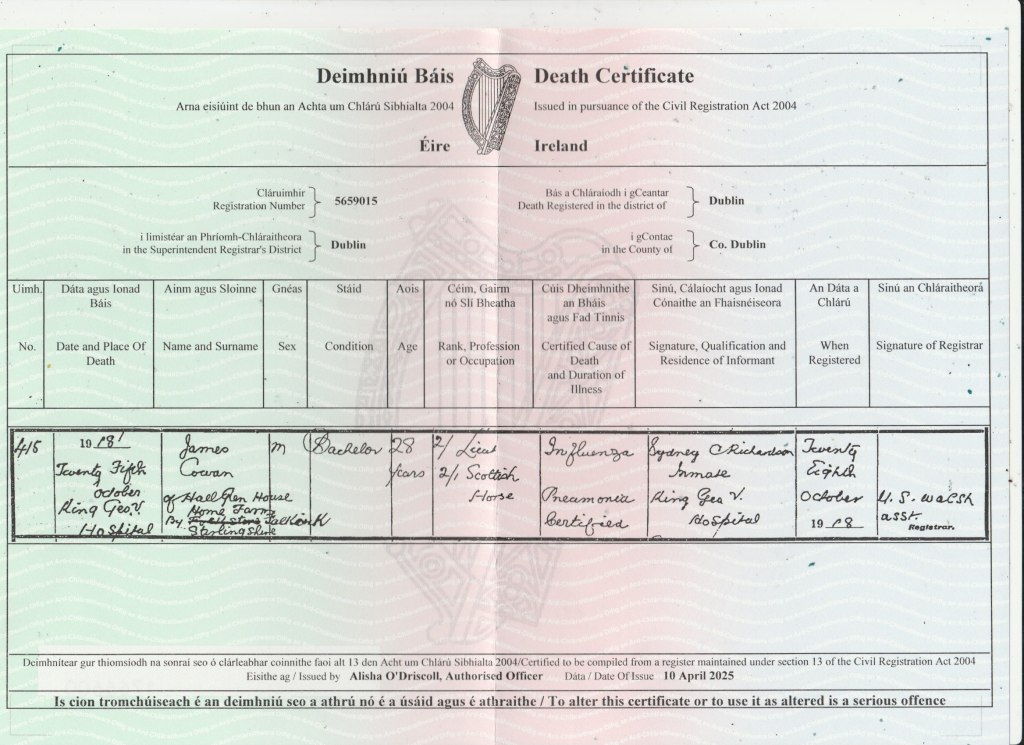
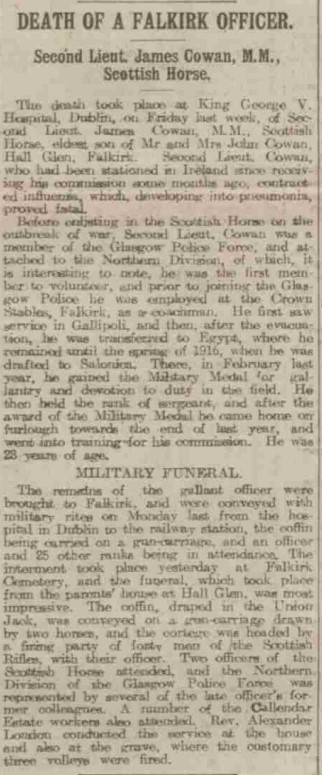
Sources: Ancestry, CWGC, Future Learn, Scotland’s People, Wikipedia
 Broken Columns