Camelon is a small town on the eastern edge of Falkirk. The name ‘Camelon’ is believed to have Arthurian connections. Camelon is also home to the Camelon Cemetery, the largest cemetery in Falkirk. The cemetery opened in 1870 to replace the overcrowded churchyard nearby. Camelon was among a new generation of landscaped or ‘garden’ cemeteries, the most famous being Kensel Green in West London. The remains of various local industrial magnates rest in Camelon Cemetery, and ornate headstones mark their graves. The cemetery expanded over the years, becoming Falkirk’s principal burial ground. After the Second World War, the cemetery became the location of Falkirk Crematorium, which opened in 1959, serving the whole of the Forth Valley until crematoria were opened in West Lothian and Stirling.
Camelon is one of my favourite cemeteries. On a recent visit, I encountered the grave of four-year-old Robert Johnstone. Robert died on Friday June 6, 1930, after being struck by a motor car. His headstone is an elegant granite plinth adorned with a statue of a young boy. I doubt the figure is an effigy of Robert but rather a symbolic expression of purity and innocence.
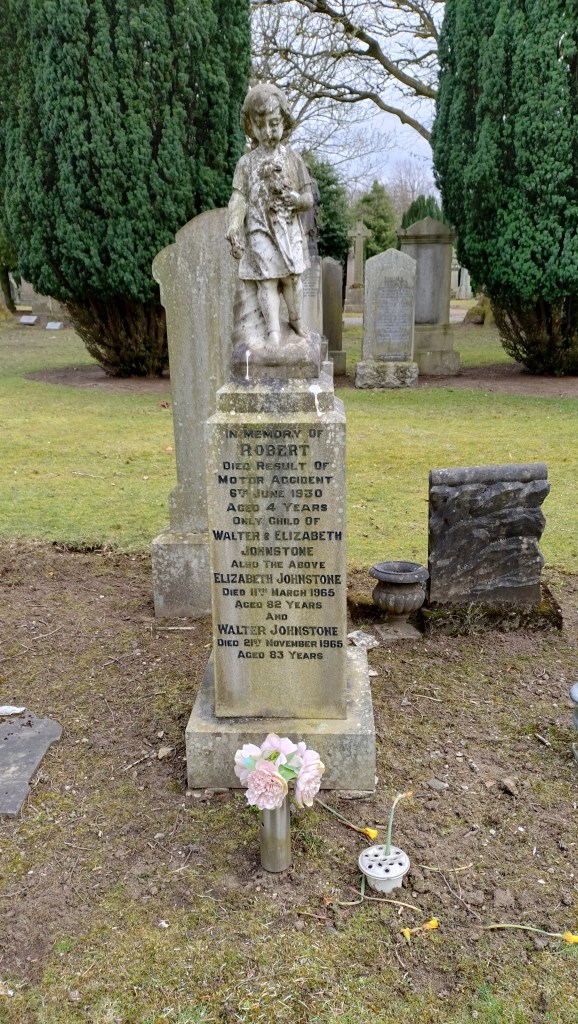
Robert Alexander Johnstone was born in Falkirk in 1926 to Walter and Elizabeth (nee Russell). He was the couple’s only surviving child, a fact acknowledged on the headstone, adding further weight to the tragedy. Described by Elizabeth as “an exceptionally active and healthy boy”, Robert was playing with his friends near his home at 35 Stirling Road, Camelon, when the tragic accident occurred. Though becoming more widespread, private motorcar ownership was relatively rare in 1930. The car was driven by Leslie Danby Chapman, a chauffeur with nine years of driving experience from Leeds, to convey his employer, Mr Cameron, from Stirling to Falkirk. His version of events, provided at the Fatal Accident and Sudden Death Enquiry at Falkirk Sheriff Court, which was published in the Falkirk Herald on October 29, states that he noted a child playing near tram rails. He sounded his horn and reduced his speed. Robert suddenly ran out at the left-hand side of the car and was knocked over. Other witnesses, including some of his friends, provided similar versions of events, though one did not recall hearing a horn or the screech of brakes. A seven-year-old named James Johnson, who had been playing with Robert, confirmed that they were lifting manure off the road with a spade. Robert left to fetch another friend and was struck by the car. He was taken to Falkirk Royal Infirmary, where he succumbed to the fatal injuries he sustained, chiefly head trauma, that same day. The jury absolved Leslie Danby Chapman of any blame for Robert’s death. I expect the events on June 6th haunted him for the rest of his life.
Elizabeth survived her only son for just short of thirty-five years. She died on March 11 1965, aged eight-two. Incidentally, I encountered the grave merely two days after the sixtieth anniversary of her passing. Walter passed that same year on November 21, aged eighty-three. They were interred with Robert in Camelon Cemetery.
Sources: British Newspaper Archive, Scotland’s People.
 Broken Columns