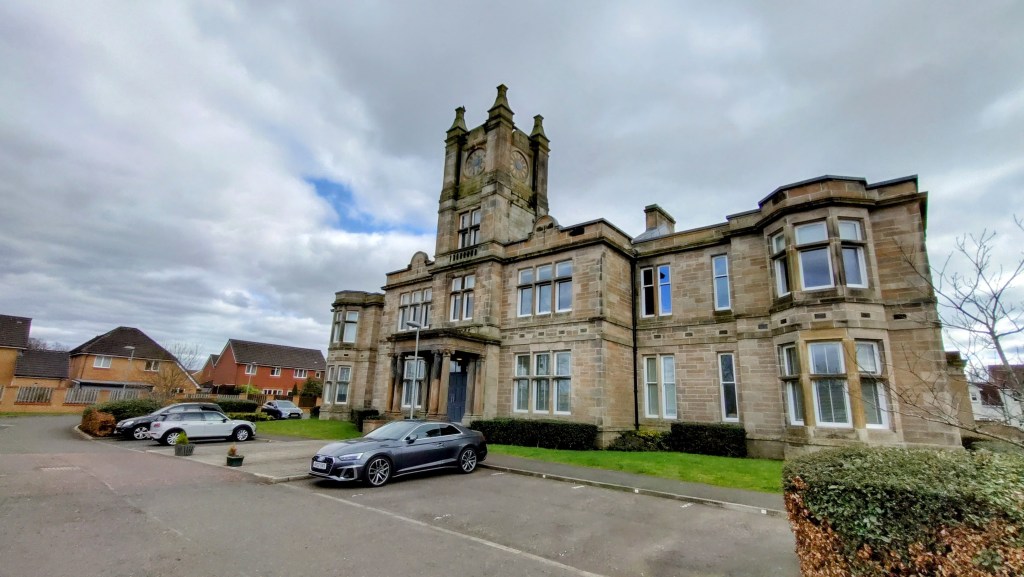
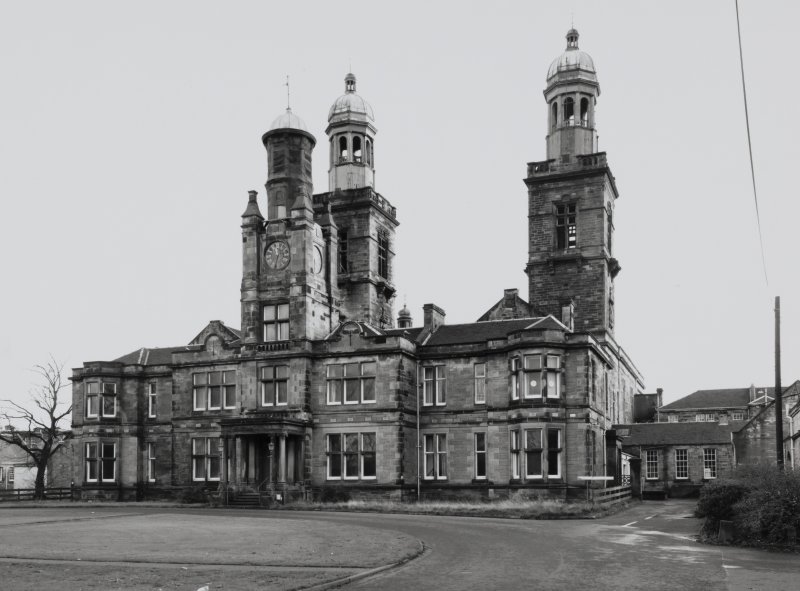
Woodilee Hospital was situated on the eastern edge of Lenzie, East Dunbartonshire. Today, nothing remains of the once extensive complex except for the main entrance building, which includes the clock tower, along with some scattered fragments.
Opened in 1875 as a lunatic asylum, Woodilee Hospital specifically catered to ‘lunatics’ from local workhouses. Compared to the severely harsh conditions found in workhouses, Woodilee Hospital was designed to offer a comfortable atmosphere for patients, capitalizing on the peace and tranquility of its rural setting.
One could argue that the facility’s design reflected more ‘progressive’ approaches to the care and treatment of the mentally ill. The complex included four farms where patients worked, and the wards were unlocked, allowing patients to wander the grounds at their leisure.
The facility expanded over the years to accommodate a broader range of patients and treatments. Progress was both the reason for the establishment of Woodilee Hospital and its eventual decline. Advances in care and treatment enabled psychiatric patients and individuals with mental disabilities to lead more independent lives. Additionally, care in institutions like Woodilee came to be seen as outdated. Health and social care policy rapidly shifted toward the “community care” model, which rendered Woodilee and similar facilities obsolete. After a gradual reduction in services, Woodilee Hospital closed its doors in 2001.
The hospital was demolished shortly after, excluding the surviving buildings mentioned above. A housing scheme now occupies the site, which incorporates the surviving buildings.
In 2005, I enrolled at Glasgow Caledonian University to complete the Honours Year of my degree. After finishing that, I went on to pursue a Master’s degree. As a stay-at-home student without a driving license, I travelled to Glasgow by train, which passed by the site of the former Woodilee Hospital. I was intrigued by the remains of the hospital. While researching John Cochrane, I discovered that he had died in Woodilee Hospital, as did Bessie Coltman. I also learned that during the First World War, psychiatric hospitals were utilised to free up beds for wounded soldiers in general hospitals, often treating patients with non-psychiatric conditions. John and Bessie died within ten days of each other, leading me to believe that influenza was endemic at Woodilee Hospital. An article in the Kirkintilloch Herald on December 12 confirmed this. Within the space of a month, forty-eight patients had died from influenza at Woodilee Hospital (credited as Woodilee Asylum). The article describes influenza as “raging” within the institution and having “claimed a great majority of the victims”. Both John and Bessie died within this time frame.

Sources: British Newspaper Archive, https://sourcenews.scot/asylums-in-glasgow-the-buildings-where-madness-was-managed/, Canmore
 Broken Columns