While I cannot confirm John’s fate as a victim of the Spanish flu, his story is incredibly compelling and deserves to be shared.
Alva Cemetery is nestled on a picturesque hillside at the eastern periphery of the town, offering serene views of the surrounding landscape. While Dr. John Michie’s final resting place is not within Alva Cemetery, he is honoured and remembered on a family headstone against the northern perimeter wall. This heartfelt tribute is a testament to his enduring legacy within the community. John passed away on December 31st in Arkhangelsk, North-West Russia, at the age of 38, where he was laid to rest in the Archangel Allied Cemetery. I was unable to find any indication of the cause of his death. Nonetheless, given his age and date of death, it is highly probable that influenza was the cause.
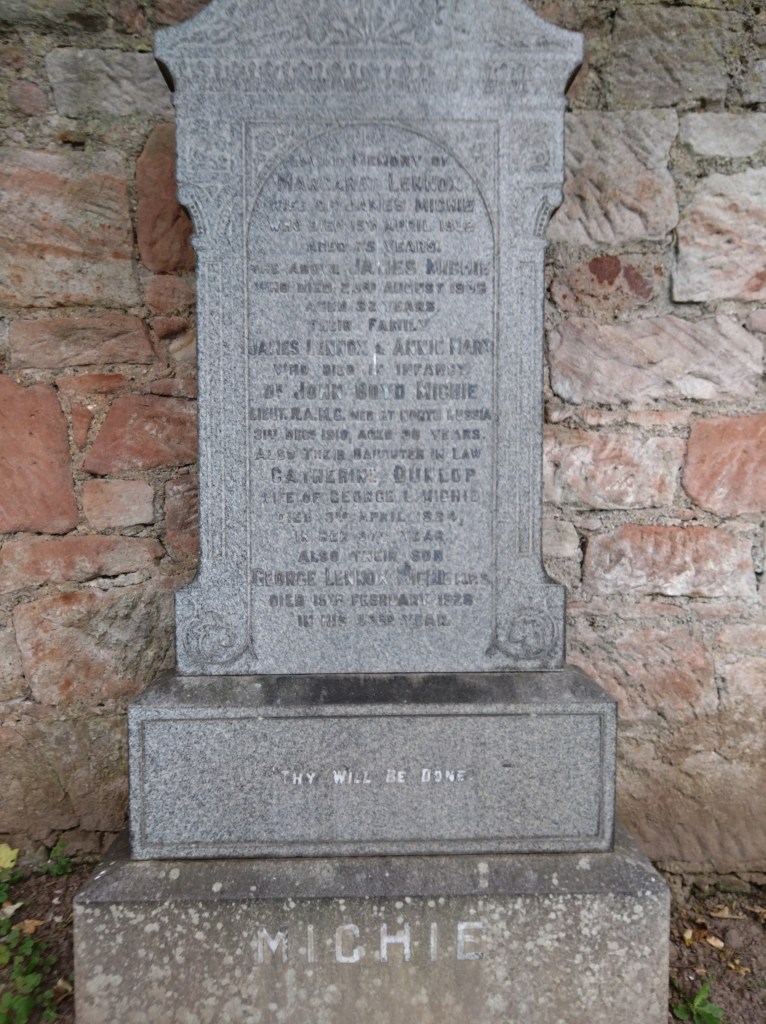

John Boyd Michie was born on September 10th, 1880, at 23 James Street, Alva. His parents, James Michie, a farmer, and Margaret (nee Lennox), welcomed him as their eldest surviving child. Six months after his birth, the 1881 Census was taken, and the family still resided on James Street. Ten years later, they had moved to 27 Erskine Street, where John, now with five younger siblings, was attending school. Over time, James and Margaret expanded their family to include ten children.
In 1901, he lived in Springburn, Glasgow, with the Blake Family at 73 Roslea Drive after leaving Alva aged 18. He worked as a chemist’s assistant, which was the first step in his medical career. Before moving to Glasgow, he had a similar role working for a local chemist. The following year aged 21, he became a fully qualified pharmacist. After managing a pharmacy for a doctor based in Glasgow, John opened his own dispensing business in Paisley, followed by another in Dennistoun. His brother took control of the pharmacies while John completed his medical training. The 1911 Census records John residing in Alva at 44 George Street with his family. He was employed as a chemist while studying medicine part-time. Once John qualified, he worked as a ‘locum’ in various locations, including Newmains, Shotts, and Whitburn. He later purchased his own medical practice.
In October 1916, John married Agnes (Nan) Allan. They had a daughter shortly after and settled at Craig Uisk in Whitburn, West Lothian. Following his passing, the West Lothian Courier published an article on January 17th honouring John’s cheerful disposition and the solace he provided to his patients. Renowned for his expertise in treating victims of coal mine accidents, John’s humility, modesty, and commitment to his working-class origins were commendable. The article also highlighted John’s rejection of the “cult of superiority” often associated with his profession.
John was finally called up for war service in September 1918, despite offering his services to the Medical Tribunal earlier. He bravely served in the Royal Army Medical Corps (RAMC). On October 29th, just days before the Armistice, John reported to Blackpool for duty. Shortly afterwards, he was sent north to Arkhangelsk on the White Sea, most likely as part of the allied North Russia Intervention against the Bolsheviks following the October Revolution of 1917. According to the earlier cited article, John did not want to be sent to North Russia or Mesopotamia. In his letters home, he vividly conveyed his dislike for northern Russia and his deep yearning to be reunited with his wife and daughter.
The cruel irony of John being called up for service so close to the Armistice did not escape his community. His passing brought profound grief to many, especially his family. Agnes was appointed executor of John’s estate in Linlithgow on April 9th, 1919.
Sources: Ancestry, British Newspaper Archive, CWGC, Scotland’sPeople
 Broken Columns